
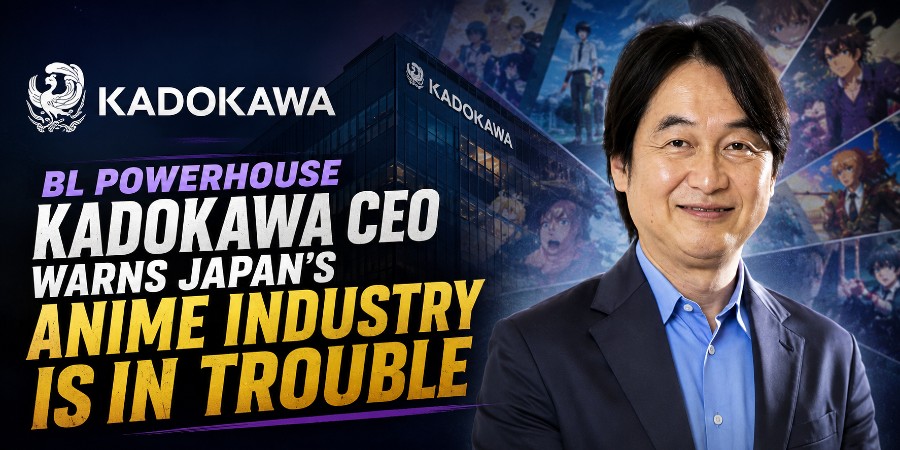
BL Powerhouse KADOKAWA CEO Warns Japan’s Anime Industry Is in Trouble
When one of anime and manga’s biggest players starts sounding the alarm about the future of the industry, people tend to pay attention.
KADOKAWA CEO Takeshi Natsuno recently sparked discussion after arguing that Japan’s anime industry has become “structurally weak” due to the sheer number of small studios operating independently.
And honestly? His comments touch on a debate anime fans have been circling around for years.
According to Natsuno, the current system is spreading talent too thin.
“Animation studios are the same. There are countless tiny companies, each with its own president and executives.”
He went on to argue that creators are being fragmented across smaller studios instead of joining larger companies with the scale to compete internationally against entertainment giants like Disney and Marvel.
“If we don’t act quickly, the anime industry is going to be hollowed out too.”
That is strong language.
And coming from KADOKAWA, it carries weight.
Why KADOKAWA’s Opinion Matters
KADOKAWA is not some outside observer commenting from the sidelines.
The company is one of Japan’s most influential entertainment powerhouses, with deep roots in manga, publishing, anime production, and light novels. It has also played a major role in the Boys’ Love space through its publishing ecosystem and adaptations connected to BL and female-targeted fandom culture.
So when the company’s CEO says the anime industry may be facing structural problems, this is not just random industry criticism. It reflects concerns coming from inside one of anime’s biggest corporate players.
Natsuno’s argument is fairly straightforward.
Japan has a huge number of small and mid-sized animation studios. While that creates variety, it also means talent, leadership, and production resources are scattered across countless companies. From his perspective, that fragmentation makes it harder for Japanese studios to build the kind of large-scale, globally competitive organizations seen in Western entertainment.
His Disney and Marvel comparison was not accidental.
The message seems clear: anime may be culturally dominant worldwide, but the business structure supporting it may not be keeping pace.
The Complicated Part Anime Fans Are Already Debating
This is where things get interesting.
Because while some people will agree with Natsuno immediately, others are probably reading those comments with raised eyebrows.
After all, anime’s creative identity has never really looked like Disney.
The industry’s strength has often come from its messy ecosystem of independent studios, specialized teams, and production committees working on wildly different kinds of projects. Big mainstream hits exist alongside niche romances, experimental originals, cult favorites, and genres that traditional media companies might consider too risky.
That diversity matters.
KADOKAWA CEO Takeshi Natsuno says Japan’s anime industry has become structurally weak because there are “too many” small companies operating independently
“Animation studios are the same. There are countless tiny companies, each with its own president and executives.”
Natsuno… pic.twitter.com/7nXlwvfM3H
— Anime Updates (@animeupdates) May 29, 2026
And it is hard to ignore the uncomfortable question sitting underneath Natsuno’s argument:
Would anime still feel like anime if it became more consolidated?
Larger companies can absolutely bring advantages. Better financing, stronger international partnerships, more production stability, and potentially less chaos behind the scenes all sound appealing—especially at a time when conversations about animator workloads and production strain continue to surface.
But consolidation also makes people nervous.
Fans worry about sameness. Creators worry about corporate priorities. And communities built around niche storytelling—including BL audiences—know firsthand that some of the most beloved projects thrive precisely because anime has never operated through a single dominant studio system.
That does not mean Natsuno is wrong.
It just means the solution may be more complicated than “bigger companies equal better anime.”
Is Japan’s Anime Industry Actually in Trouble?
That depends on what “trouble” means.
Anime itself is not disappearing. Global demand continues to grow, streaming has expanded international reach, and anime fandom has arguably never been more visible.
But financial success and structural stability are not always the same thing.
Natsuno appears to be warning about the long-term foundation underneath that success—whether Japan’s current studio landscape can sustain itself while competing in an increasingly global entertainment economy.
And that conversation is probably not going away anytime soon.
For anime fans, this may end up being less about choosing sides and more about recognizing the tension at the center of the industry.
Anime became beloved partly because it was never built like Hollywood.
The real question is whether that same system can continue thriving in the future—or whether changing it risks losing some of the creative chaos that made anime special in the first place.








Leave a Reply