
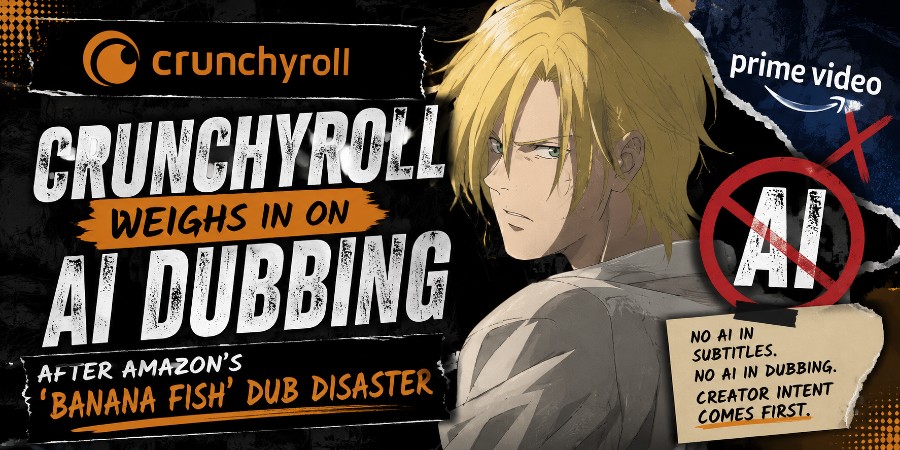
Crunchyroll Weighs In on AI Dubbing After Amazon’s ‘Banana Fish’ Dub Disaster
Crunchyroll is clarifying its position on AI in anime localization after Amazon’s controversial Banana Fish AI dub sparked backlash among fans.
AI and anime have become an increasingly tense combination lately, and fans have had plenty of reasons to be cautious.
After Amazon’s controversial AI-generated Banana Fish English dub sparked backlash and was ultimately removed, conversations around AI localization have only grown louder. Now, Crunchyroll CEO Rahul Purini is offering what may be the company’s clearest position yet on where AI fits—and where it doesn’t.
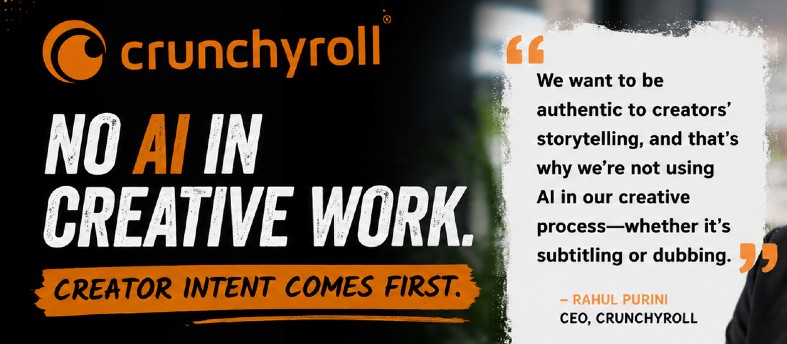
According to comments made to Radio Times, Purini says Crunchyroll does not intend to use AI in its own creative subtitling or dubbing process.
• Crunchyroll says it is not using AI in creative subtitling or dubbing
• CEO Rahul Purini emphasized creator authenticity and intent
• AI is still being explored for recommendations and personalization
• The comments arrive after growing concern over AI localization and Amazon’s Banana Fish controversy
Crunchyroll Says Creator Intent Comes First
Purini addressed the challenge of navigating AI use directly, making it clear that Crunchyroll views creator authenticity as the guiding principle.
“We have always said creator authenticity is really important for us… we want to be authentic to their storytelling, and so that’s why we’re not using AI in our creative process – whether it’s subtitling or dubbing.”
That wording matters.
For anime fans worried about AI replacing translators, writers, or voice talent, this is the strongest public statement Crunchyroll has made so far regarding localization.
Purini explained that creators themselves can choose whatever technology they want to tell their stories, but Crunchyroll’s own role is centered around preserving creator intent rather than reshaping it through automation.
At the same time, the company is not abandoning AI entirely.
Purini reiterated that AI is still being explored for recommendation systems, personalization tools, and helping users discover new series. In other words, Crunchyroll appears comfortable using AI on the platform side of the business—but not inside the creative localization process itself.
Why Fans Are Paying Close Attention
These comments are arriving in an anime landscape that is already deeply skeptical about AI dubbing.
As Mom Unfiltered previously covered during the Banana Fish AI dub controversy, fan criticism was never just about whether a dub sounded awkward or unfinished.
The larger concern was trust.
When Amazon released an AI-generated English dub for Banana Fish, many viewers criticized the performances as emotionally flat and unnatural while raising bigger concerns about what AI localization could mean for voice actors and translators moving forward.
That backlash quickly snowballed into a wider industry conversation about whether AI should have a place in anime dubbing at all.
We covered the initial controversy, the growing debate surrounding AI English dubbing, and eventually Amazon’s decision to remove the dub entirely. For many fans, that removal became proof that this debate was not simply online outrage—it reflected genuine concerns about quality and the role of human creativity in anime localization.
Crunchyroll CEO Rahul Purini says the company will respect creators’ decisions on whether to use AI in their work, but says Crunchyroll itself will not use AI for subs or dubs
“We want to make sure creators get to tell the stories the way they want to tell them, whatever… pic.twitter.com/inbHddH518
— Anime Updates (@animeupdates) May 31, 2026
Crunchyroll’s AI Comments Haven’t Always Been This Clear
Part of why Purini’s latest statement is drawing attention is because Crunchyroll’s position has evolved—or at least become more clearly defined—over time.
Back in 2024, Purini spoke about AI experimentation in localization workflows, particularly involving subtitles and closed captioning.
“AI is definitely something that we think about… one of the areas we are very focused on testing is our subtitling and closed captioning.”
At the time, the focus was described as speech-to-text optimization and speeding up subtitle production so simulcasts could launch closer to Japanese release windows.
Purini also acknowledged that AI dubbing was being explored in some capacity, though he stressed the technology was not ready and pointed to the complexity of adapting humor, performance, and lip-syncing.
Those earlier comments left room for interpretation.
More recently, Purini told Forbes that Crunchyroll was not considering AI in the creative process, particularly regarding voice acting, though questions remained about whether subtitles and captioning fell under that same promise.
The Radio Times interview appears to settle that ambiguity by explicitly including subtitling and dubbing under Crunchyroll’s no-AI creative process position.
The Debate Is Probably Not Going Away
Even with this clarification, AI discussions surrounding anime localization are unlikely to disappear anytime soon.
Crunchyroll itself has already faced uncomfortable AI-related questions. Earlier this year, viewers noticed AI-generated subtitles supplied through a third-party vendor, including the now-infamous “ChatGPT said” text appearing on screen.
Crunchyroll responded by stating that the AI usage violated vendor agreements and that the company was investigating the issue, though the full results of that investigation were never publicly shared.
That incident, combined with Amazon’s Banana Fish backlash, helps explain why fans are scrutinizing every AI-related comment coming from major anime platforms.
And there is another layer to this conversation.
While Crunchyroll says it will not use AI in its own creative localization process, the company is deeply connected to anime production through committee investments and Sony-affiliated studios that are openly experimenting with AI production tools. That means the broader industry conversation around AI and anime creation is still evolving.
What This Means for Anime Fans
Right now, Crunchyroll appears to be drawing a line between AI-assisted platform tools and AI-generated creative work.
For viewers worried about subtitles, dubbing, and creator intent, that distinction may offer some reassurance.
But if the reaction to Banana Fish proved anything, it is that anime fans are paying closer attention than ever to how localization gets made—and who, or what, is doing the work.
Crunchyroll’s latest comments may be the clearest answer yet, but they probably won’t be the final word in anime’s growing AI debate.








Leave a Reply