
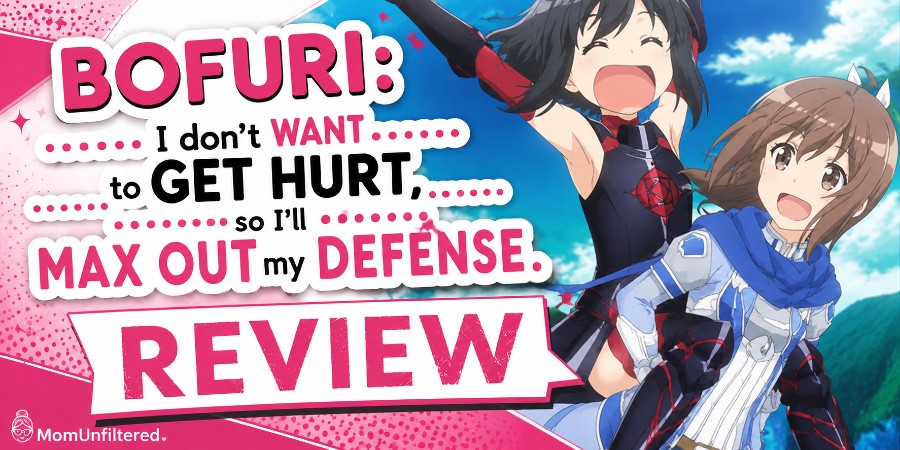
Sometimes an anime doesn’t need to be amazing to be enjoyable.
That’s pretty much where I landed with BOFURI: I Don’t Want to Get Hurt, so I’ll Max Out My Defense.
After finishing both seasons, I wouldn’t put it anywhere near my all-time favorites, and I don’t think it’s one of those legendary comfort-watch series that I’ll revisit every year. But I also burned through all 24 episodes surprisingly fast, smiled through most of it, and found myself genuinely attached to the cast by the end.
It’s cute. It’s funny. It’s easy to watch. And if you’re someone who enjoys anime that take place inside video games, there’s a very good chance you’ll have a great time with it.
What BOFURI Is Actually About
The premise is wonderfully simple.
Maple is a complete gaming newbie. Her friend Sally convinces her to try a new VRMMO, but Sally gets delayed by schoolwork and can’t start at the same time. Left on her own, Maple makes what should be a terrible decision.
She decides she doesn’t want to get hurt.
So she puts every single stat point into defense.
That’s it. That’s the entire joke.
What makes BOFURI work is that Maple isn’t some hidden gaming genius. She’s not trying to exploit the system. She’s not secretly min-maxing.
She’s just making decisions that seem logical to her.
Then the game keeps rewarding those decisions in increasingly ridiculous ways until she accidentally becomes one of the most terrifying players on the entire server.
Before long, Maple is unlocking bizarre abilities, surviving encounters she probably shouldn’t survive, and constantly discovering new ways to completely break the game’s balance.
And honestly? It’s hilarious.
Quick Verdict
- Score: 6.5/10
- Episodes: 24 Episodes (Two Seasons)
- Genre: Fantasy, Slice of Life
- Watch If: Fans of MMO anime, cozy gaming adventures, wholesome friend groups, and low-stress binge watches.
- Verdict: Not a masterpiece, but an easy recommendation if you enjoy anime set inside video games.
The Developers Are Secretly Some of the Funniest Characters
One of my favorite recurring gags throughout the series isn’t even Maple herself.
It’s the developers.
Every time Maple discovers another absurd skill combination, the developers immediately go into crisis mode.
They add nerfs.
They redesign events.
They try to create counters.
They tweak the game’s balance.
And somehow Maple still finds a way to accidentally become even stronger.
Watching the developers slowly realize they have created a monster never stopped being funny.
The series treats game balance like a comedy routine, and those scenes ended up being some of the biggest laughs for me.
The Real Strength of BOFURI Is Its Characters
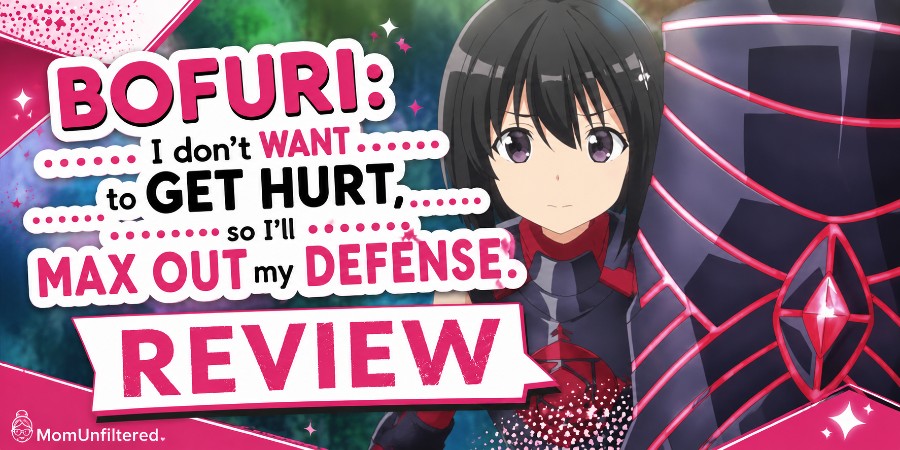
If BOFURI has a secret weapon, it’s the cast.
Maple is incredibly easy to root for because she’s never arrogant. Despite becoming ridiculously overpowered, she stays kind, enthusiastic, and genuinely excited about everything she discovers.
Sally works as the perfect counterpart. She’s more experienced, more strategic, and often serves as the grounded half of the duo.
Together, they’re easily the emotional core of the series.
I completely understand why fans ship them.
To be clear, BOFURI is not a romance anime. There’s really no romantic storyline here at all. But Maple and Sally care about each other so much, constantly save each other, and have such strong chemistry that it’s easy to see why parts of the fandom gravitated in that direction.
Whether you view them as best friends or something more, they’re simply fun to watch together.
I also ended up loving the rest of Maple Tree.
The guild feels less like a competitive MMO guild and more like a collection of lovable oddballs who somehow stumbled into becoming one of the strongest groups in the game.
The twin sisters in particular were adorable. They’re basically Maple’s spiritual successors, dumping all their points into Strength and creating an entirely different set of problems for themselves.
They’re ridiculously powerful and somehow still require constant supervision.
By the end of the series, half the cast seems to share the same concern:
“Where are the twins?”
And honestly, that’s fair.
The Capture-the-Flag Arc Is the Highlight of the Series
If there’s one section of BOFURI I would specifically tell people to pay attention to, it’s the orb event.
It’s basically the show’s version of capture the flag.
Guilds must defend their own orb while stealing orbs from rival guilds.
This event showcases everything BOFURI does best.
Maple Tree starts at a disadvantage because they’re a smaller guild. They can’t simply overpower everyone else through numbers.
Instead, they do what Maple always does.
They find creative ways to completely change how the event is played.
The strategy, teamwork, character interactions, and guild dynamics all come together beautifully during this stretch.
For me, it’s easily the strongest part of the entire series.
If I were ever going to revisit specific episodes, it would probably be those.
What Makes BOFURI Feel Different From Other MMO Anime
One thing I really appreciated is how wholesome the overall atmosphere remains.
Many MMO anime focus heavily on rivalries, betrayals, or toxic competition.
BOFURI doesn’t.
The rival guilds start as competitors, but over time they develop genuine respect and friendship.
By the final episodes, guild boundaries matter less than the relationships between the characters.
I loved seeing unexpected character pairings form.
Characters who rarely interacted suddenly got moments together. Support characters were paired with other support characters. Rival guild members worked side by side.
The world gradually feels less like opposing teams and more like a gaming community.
That sense of friendship ends up being surprisingly heartwarming.
A Surprisingly Family-Friendly Anime
As a mom who reviews anime, I think this is worth mentioning.
BOFURI is one of the easiest anime I’ve watched when it comes to family viewing.
There’s very little fan service overall. One side character leans harder into that territory than the rest of the cast, but she’s a relatively minor presence.
Outside of that, there’s really nothing here that would make me rush for the remote if my kids walked into the room.
It’s also a fantastic background-watch anime.
You can put it on while cooking dinner, doing dishes, folding laundry, or working around the house without feeling completely lost if your attention drifts for a few minutes.
That’s not a criticism.
It’s part of the show’s charm.
BOFURI is comfortable viewing.
What Didn’t Quite Work for Me
Honestly, I don’t have many complaints.
Most of the things keeping this from scoring higher are less about flaws and more about impact.
While I enjoyed almost everything about it, very little felt extraordinary.
I liked the characters.
I liked the setting.
I liked the humor.
But I never reached the point where I felt obsessed with it.
This isn’t one of those series that immediately joins my list of all-time favorites.
It’s simply a really enjoyable show that consistently does what it sets out to do.
I also wasn’t particularly invested in the end-of-episode forum comments. They moved too quickly for me to care enough to pause and read them.
My biggest frustration, however, is the post-credit scene at the end.
The actual finale works surprisingly well.
The characters reach a satisfying place.
The guild relationships feel complete.
The story feels finished enough.
Then the post-credit scene shows up and practically screams, “To be continued.”
That would be fine if a third season had followed.
Unfortunately, years later, we’re still waiting.
If I’m being honest, I’d almost recommend treating the main ending as the real ending and skipping the sequel tease altogether.
Final Verdict
BOFURI earned a solid 6.5/10 from me.
That’s not a score of disappointment.
It’s a score of appreciation.
The series is funny, charming, wholesome, and consistently entertaining. Maple is lovable, Sally is great, the guild dynamics are wonderful, and watching the developers panic over Maple’s latest game-breaking ability never gets old.
It’s not a masterpiece.
It’s not peak anime.
But if you enjoy anime set inside video games, this is an easy recommendation.
Sometimes a show doesn’t need to change your life.
Sometimes it just needs to make you smile for 24 episodes.
BOFURI does exactly that.








Leave a Reply