If you’ve recently seen anime fans talking about the upcoming BL adaptation Perfect Addiction and wondering why people keep calling it a “light anime,” you’re definitely not alone.
The phrase has been popping up more often lately, especially as new manga adaptations get announced using the format. And judging by fan reactions online, plenty of people are still trying to figure out what a light anime actually is.
Some viewers are curious. Others are skeptical. And a few seem personally offended by the very concept.
So what exactly is a light anime, why are companies investing in it, and why is the format suddenly getting attention through boys’ love adaptations like Perfect Addiction?
What Is a Light Anime?
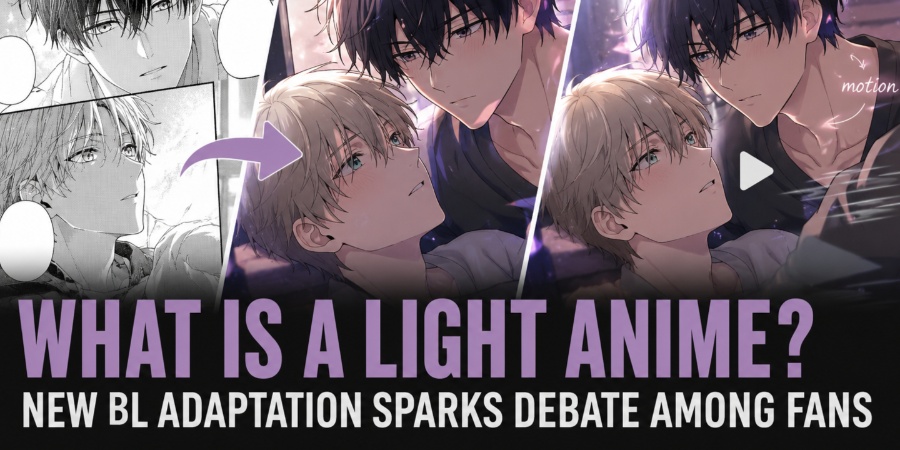
At its core, a light anime is a faster and lower-cost style of anime production that uses manga artwork itself as the foundation for animation.
Unlike traditional anime, which requires animators to draw thousands of new frames from scratch, light anime works directly from manga pages. Speech bubbles and text are removed, panels are separated and colored, and movement, effects, music, and voice acting are added to create an animated viewing experience.
Think of it as landing somewhere between a manga, an audio drama, and a traditional anime adaptation.
That explanation alone surprises a lot of fans.
One Reddit user reacting to recent announcements admitted:
“TIL about light animes”
Another joked:
“I thought that meant there wouldn’t be any sex scenes or something.”
And honestly? That confusion is understandable.
The term “light anime” still feels relatively new outside Japan, even though companies have been quietly developing the production model for several years.
Why Japan Created Light Anime
Light anime was not invented simply because studios suddenly decided to animate less.
The format was developed as a response to growing pressure inside the anime industry itself.
Dai Nippon Printing, often shortened to DNP, announced the Light Anime production method as a way to significantly reduce both production time and cost. According to company statements, the goal was to make anime adaptations possible for a wider range of manga while easing some of the bottlenecks that come with traditional production.
That context matters.
Anime has become a massive global business, with the Japanese animation market reaching trillions of yen in value. But despite that growth, only a relatively small number of manga ever receive full anime adaptations.
The reasons are not hard to understand.
Traditional anime production is expensive, labor-intensive, and slow.
Large television productions can involve hundreds of staff members and thousands of individual drawings or frames. Some productions reportedly use anywhere from 3,000 to more than 10,000 images depending on complexity and animation quality.
Light anime approaches the problem differently.
Instead of rebuilding an entire story from scratch through frame-by-frame animation, the original manga artwork remains the foundation.
That dramatically changes the production timeline.
Reports surrounding the format have suggested that light anime may be produced for roughly 10% of the cost of traditional TV animation while using much smaller teams.
Major Companies Are Taking Light Anime Seriously
If light anime still sounds like a niche experiment, this is where things get interesting.
One of Japan’s largest media and production companies, Imagica Group, has already entered the space through a partnership focused on full-scale light anime production.
Under reported plans, series could run between six and twelve episodes with shorter runtimes while airing on television and streaming services.
That move signaled something important to many observers:
Light anime is no longer just a proof of concept.
Major companies appear to believe the format has real commercial potential.
Imagica representatives have even argued that when strong direction and talented voice actors are involved, the final product can reach a surprisingly high level of quality.
Whether fans agree with that statement, however, is another story entirely.

Why New BL Adaptations Are Bringing Attention to Light Anime
This is where series like Perfect Addiction enter the conversation.
The upcoming BL adaptation has introduced many anime fans to the light anime format for the first time, creating curiosity and debate at the same time.
If you missed the announcement, Perfect Addiction recently revealed its cast and premiere details as part of its upcoming light anime adaptation.
And honestly? BL and romance manga may be uniquely suited to this style of production.
That is not because BL somehow “belongs” in light anime, but because many romance-heavy stories rely more on dialogue, chemistry, facial expression, emotional tension, and character interactions than large-scale action choreography or animation spectacle.
For publishers and studios, that creates an interesting opportunity.
Light anime allows certain manga to preserve the feel of their original artwork while reaching viewers more quickly and with fewer production hurdles.
That may help explain why romance and BL titles appear so frequently in discussions surrounding the format.
Anime Fans Are Still Split on the Format
Of course, not everyone is sold on the idea.
Some fans see light anime as a practical solution that could bring more manga to screens and help smaller or niche titles find an audience.
Others worry that the industry may be prioritizing cheaper production rather than addressing larger problems surrounding working conditions and scheduling.
One particularly blunt fan reaction summed up the frustration this way:
“If there was ever a sign that demand is outpacing supply for anime it’s the existence of ‘light anime.’ Literally just moving manga panels.”
That criticism reflects a larger debate already happening inside anime fandom.
Are light anime an exciting new format that expands adaptation opportunities… or are they simply a shortcut?
Right now, the answer probably depends on who you ask.
Final Thoughts on Light Anime
Light anime may not replace traditional animation anytime soon, and most fans would probably agree that it shouldn’t.
But it also does not appear to be disappearing.
Between industry investment, lower production costs, and new projects like Perfect Addiction, the format is clearly gaining momentum.
And whether viewers end up loving light anime or rolling their eyes at it, one thing is becoming increasingly obvious:
Anime fans are going to keep hearing about it.








Leave a Reply